The Hayes and Wheelwright model (often referred to as the four-stage model of operations strategy or manufacturing's strategic role) is a foundational framework in operations management. Developed by Harvard professors Robert H. Hayes and Steven C. Wheelwright in their 1984 book *Restoring Our Competitive Edge: Competing Through Manufacturing* (building on their earlier 1979 work), it describes how an organization's operations function (manufacturing or service delivery) evolves in its contribution to overall business strategy and competitive advantage.
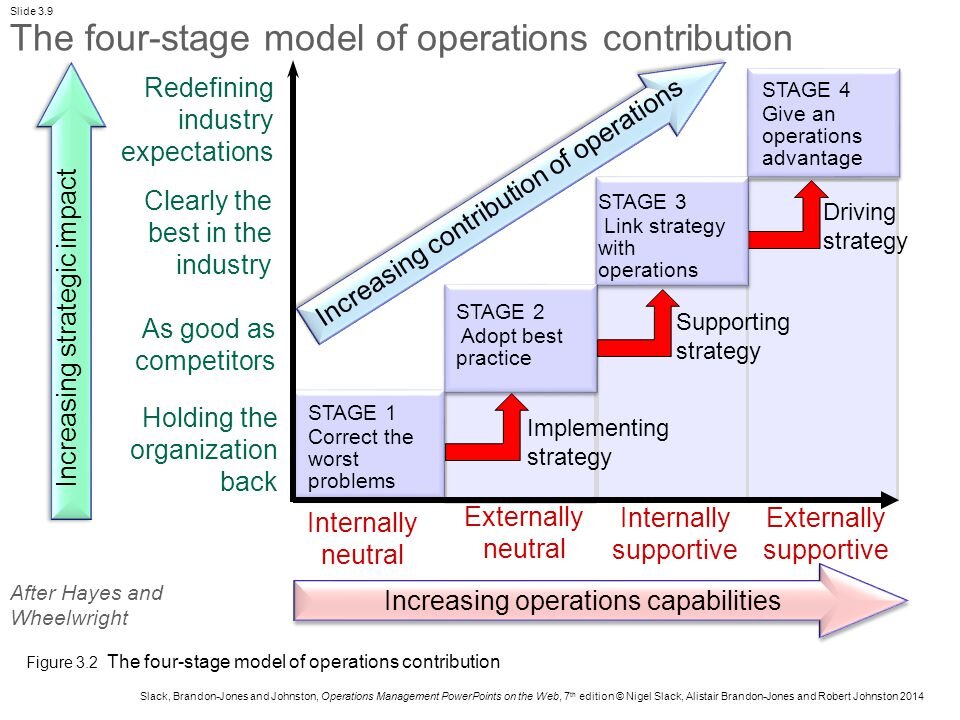
The model presents operations as progressing through four stages, from being a neutral (or even negative) factor to becoming a powerful source of competitive edge. It is typically visualized as a 2x2 matrix with two axes:
- Internal vs. External focus
- Neutral vs. Supportive contribution
The Four Stages Explained
Stage 1: Internally Neutral
This is the lowest level of maturity. Operations are viewed as a **barrier** or "necessary evil" by other parts of the business. The primary goal is to **avoid mistakes** and minimize negative impact on the rest of the organization (e.g., preventing breakdowns, quality issues, or delays). Operations are reactive, inward-looking, and lack strategic direction. They simply "make the stuff" without surprises, but underperform consistently, holding the company back. Many struggling or immature organizations start here.
Stage 2: Externally Neutral
The operations function breaks out of internal negativity by benchmarking against competitors and adopting **industry best practices**. The aim is to achieve **parity** — to be as good as (but not better than) rivals in terms of cost, quality, delivery, etc. Operations adopt standard approaches (e.g., similar suppliers, quality systems, or workforce practices) to meet external benchmarks. This stage is common for most companies: operations are no longer a weakness, but they don't create any unique advantage.
Stage 3: Internally Supportive
Here, operations become **proactively aligned** with the business strategy. The function develops a credible operations strategy that supports the overall competitive priorities (e.g., low cost, differentiation, speed, or flexibility). Operations reach "best in class" levels within the industry and are coordinated with structural (e.g., capacity, technology) and infrastructural (e.g., workforce, quality systems) decisions. The business can now exploit operations capabilities for better pricing, faster delivery, or superior products to gain market share. This is where operations truly support and enable the strategy.
Stage 4: Externally Supportive
The rarest and highest level — operations become the foundation of the company's competitive success. The function is innovative, proactive, and forward-looking, often driving the entire business strategy. Operations provide unique capabilities that competitors can't easily match (e.g., breakthrough processes, flexibility, or technology leadership), putting the company "one step ahead." The organization builds its strategy around what operations can deliver, creating sustainable advantage. Very few companies reach this stage (examples historically include world-class performers like Toyota in its prime or certain tech giants today).
Key Insights from the Model
- Progression is sequential: Organizations typically move upward from Stage 1 → 2 → 3 → 4 as they mature.
- Stages 1 and 2 are neutral (operations neither help nor significantly harm strategy).
- Stages 3 and 4 are supportive (operations actively contribute to success).
- The shift from internal to external focus marks a major leap in strategic impact.
- The model is both descriptive (how operations currently contribute) and prescriptive (encouraging ascent to higher stages for competitive edge).
Applications and Relevance
Originally focused on manufacturing, the model applies equally to services, supply chains, and modern digital operations. It remains highly relevant in 2026 for assessing how operations (including AI-driven processes, sustainability, or agile manufacturing) can move beyond parity to true differentiation.
In summary, the Hayes and Wheelwright model reminds us that great companies don't treat operations as a back-office function — they elevate it to become a strategic weapon. Ascending the stages requires deliberate investment in capabilities, alignment, and innovation.


No comments:
Post a Comment