Tuesday, January 13, 2026

Hayes Wheelwright Model (1985) ..

The Hayes and Wheelwright model (often referred to as the four-stage model of operations strategy or manufacturing's strategic role) is a foundational framework in operations management. Developed by Harvard professors Robert H. Hayes and Steven C. Wheelwright in their 1984 book *Restoring Our Competitive Edge: Competing Through Manufacturing* (building on their earlier 1979 work), it describes how an organization's operations function (manufacturing or service delivery) evolves in its contribution to overall business strategy and competitive advantage.
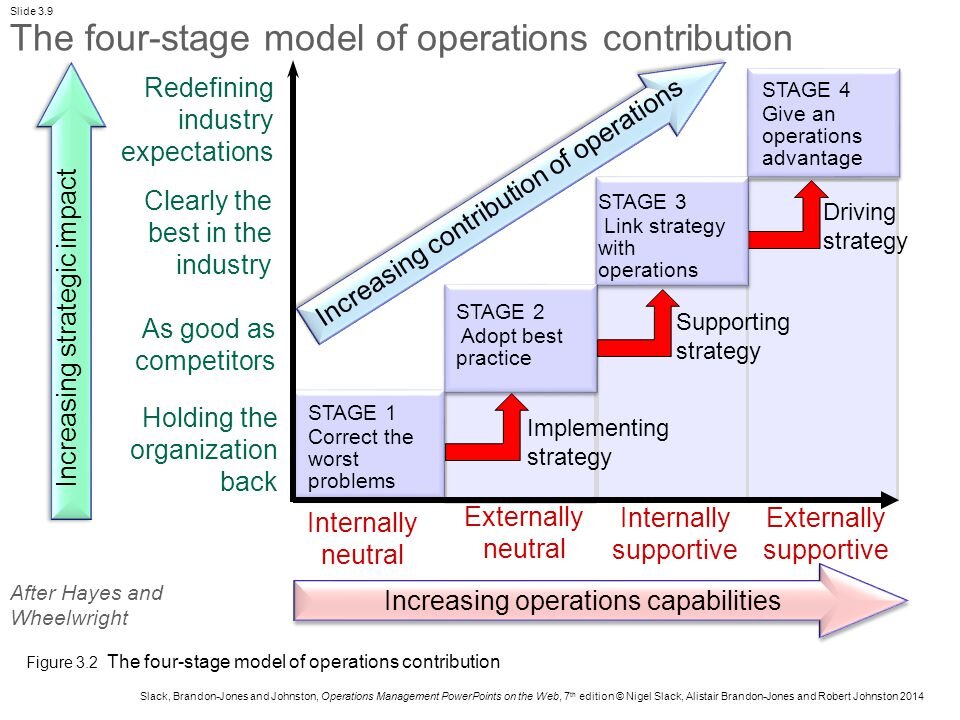
Four-Stage Model of Operation and Competitiveness — NIGEL CHETTY


The model presents operations as progressing through four stages, from being a neutral (or even negative) factor to becoming a powerful source of competitive edge. It is typically visualized as a 2x2 matrix with two axes:

- Internal vs. External focus  
- Neutral vs. Supportive contribution  


The Four Stages Explained

Stage 1: Internally Neutral  
This is the lowest level of maturity. Operations are viewed as a **barrier** or "necessary evil" by other parts of the business. The primary goal is to **avoid mistakes** and minimize negative impact on the rest of the organization (e.g., preventing breakdowns, quality issues, or delays). Operations are reactive, inward-looking, and lack strategic direction. They simply "make the stuff" without surprises, but underperform consistently, holding the company back. Many struggling or immature organizations start here.

Stage 2: Externally Neutral  
The operations function breaks out of internal negativity by benchmarking against competitors and adopting **industry best practices**. The aim is to achieve **parity** — to be as good as (but not better than) rivals in terms of cost, quality, delivery, etc. Operations adopt standard approaches (e.g., similar suppliers, quality systems, or workforce practices) to meet external benchmarks. This stage is common for most companies: operations are no longer a weakness, but they don't create any unique advantage.

Stage 3: Internally Supportive  
Here, operations become **proactively aligned** with the business strategy. The function develops a credible operations strategy that supports the overall competitive priorities (e.g., low cost, differentiation, speed, or flexibility). Operations reach "best in class" levels within the industry and are coordinated with structural (e.g., capacity, technology) and infrastructural (e.g., workforce, quality systems) decisions. The business can now exploit operations capabilities for better pricing, faster delivery, or superior products to gain market share. This is where operations truly support and enable the strategy.

Stage 4: Externally Supportive
The rarest and highest level — operations become the foundation of the company's competitive success. The function is innovative, proactive, and forward-looking, often driving the entire business strategy. Operations provide unique capabilities that competitors can't easily match (e.g., breakthrough processes, flexibility, or technology leadership), putting the company "one step ahead." The organization builds its strategy around what operations can deliver, creating sustainable advantage. Very few companies reach this stage (examples historically include world-class performers like Toyota in its prime or certain tech giants today).

Key Insights from the Model
- Progression is sequential: Organizations typically move upward from Stage 1 → 2 → 3 → 4 as they mature.  
- Stages 1 and 2 are neutral (operations neither help nor significantly harm strategy).  
- Stages 3 and 4 are supportive (operations actively contribute to success).  
- The shift from internal to external focus marks a major leap in strategic impact.  
- The model is both descriptive (how operations currently contribute) and prescriptive (encouraging ascent to higher stages for competitive edge).

Applications and Relevance
Originally focused on manufacturing, the model applies equally to services, supply chains, and modern digital operations. It remains highly relevant in 2026 for assessing how operations (including AI-driven processes, sustainability, or agile manufacturing) can move beyond parity to true differentiation.

In summary, the Hayes and Wheelwright model reminds us that great companies don't treat operations as a back-office function — they elevate it to become a strategic weapon. Ascending the stages requires deliberate investment in capabilities, alignment, and innovation.

What happened at Indigo airlines in India ?

This discussion would not have happened in any other academic campus in the country. 
The Indigo employees were used to a highly efficient hectic safe work schedule across the country. This was disturbed by the assessment of potential future health problems of employees in flights endangering passenger safety and the govt organised initiatives inclyding reducing weekly work hours and schedule for flying staff meant with good intentions to improve flight safety in general across the country. 

Indigo took it easy and did not take enough precautions early on to increase flight crew, as lean principles and high employee utilisation were topmost in their mind. They delayed implementation of govt policies leading to the issue.

Thursday, January 01, 2026

Deep Learning output, from a blackbox ?

Deep learning models, particularly large neural networks like those used in computer vision or natural language processing, are generally considered "black boxes." This means that while we can observe the inputs and outputs, the internal workings—such as exactly which neuron processes which specific piece of information—are not transparently understandable.

When can this be properly understood or analysed ? Is the output from Deep Learning systems optimised or randomised ? Can we understand working of Deep Learning systems better ? Can any other digital system optimally replace this blackbox of neurons and network ? 

Monday, December 29, 2025

Apple's new Operations strategy


Beyond 'Made in China': The New Reality of How Your iPhone is Built

1.0 Introduction: The Secret Journey of Your Devices

There's a unique satisfaction in unboxing a new Apple product—the clean packaging, the precise design, the immediate sense of quality. Holding that device, it feels like a self-contained piece of magic. But have you ever paused to consider the complex global journey it took to reach your hands? The story of how that product was made is far more intricate than the simple "Assembled in..." text suggests.

That global manufacturing map is currently undergoing a seismic shift. For years, Apple's strategy was synonymous with massive-scale production in China. Today, a new model is emerging, driven by the powerful forces of geopolitics, escalating costs, and the urgent pursuit of a more resilient supply chain. This isn't just a minor course correction; it's a fundamental rewiring of one of the world's most sophisticated production networks.

This article reveals four of the most surprising and counter-intuitive truths about Apple's modern supply chain. Based on its 2025 strategy, these insights debunk common myths and provide a clearer picture of how the world's most valuable tech company is building its products for a new, more unpredictable era.

2.0 1. China Isn't Being Abandoned, It's Being Balanced

The common narrative suggests that Apple is in a full-scale retreat from China. The reality is far more nuanced. Instead of pulling out, Apple is implementing a sophisticated "China Plus One" strategy, which focuses on diversification rather than departure.

The data makes this clear. While China's dominance has lessened from its 2018 peak when it hosted 60-70% of electronics manufacturing facilities, it remains the powerful core of Apple's operations. As of 2025, China still accounts for a formidable 40-50% of Apple's facilities and an estimated 65% of its total production.

This strategy is significant because Apple is not willing to abandon the unparalleled efficiency and specialized expertise of the Chinese manufacturing ecosystem, especially for critical inputs like precision components and advanced assembly for products like the Apple Vision Pro, which remains exclusively in China. Instead, it is building parallel capabilities in other nations to serve as a crucial hedge against disruption. The goal is to create a more balanced and resilient network, not to dismantle the engine that powered its growth for over a decade.

3.0 2. Trade Wars Have a Staggering, Nine-Figure Price Tag

For most consumers, tariffs are an abstract political concept. For Apple, they represent a concrete and massive financial burden. The ongoing trade tensions between the U.S. and China have a direct and staggering impact on the company's bottom line.

In 2025, U.S. tariffs on Chinese imports added $800-900 million in quarterly costs for Apple. This nine-figure quarterly expense is not an abstract risk; it is a direct catalyst forcing Apple's hand. The need to mitigate this specific cost is the primary financial imperative behind moving final assembly of U.S.-bound iPhones to tariff-free locations like India.

But shifting production is just one part of a multi-pronged defense. Apple's strategy also includes stockpiling components to buffer against price shocks and making significant U.S. investments in areas like semiconductor production to qualify for domestic incentives and exemptions. This turns a political headline into a tangible business imperative, demonstrating a sophisticated response to geopolitical financial risk.

4.0 3. India Is Becoming a Premier Hub, Not Just a Backup Plan

A common assumption about supply chain diversification is that new manufacturing locations are relegated to producing older, lower-end products while the core facilities handle the flagship models. Apple's strategy in India directly challenges this notion, revealing a rapid and strategic elevation of the country's role.

The speed and scale of India's growth within Apple's network are remarkable. In 2025, India produces 44% of all U.S.-bound iPhones, a massive leap from just 13% the previous year. This growth is backed by major capital investment, exemplified by projects like Foxconn's $1.5 billion facility in Tamil Nadu, which has already created 14,000 jobs.

Even more significant is the type of work being done. For the first time, premium models like the iPhone 16 Pro are being assembled in India, signaling deep confidence in the region's capabilities. With projections indicating India could handle 25% of global iPhone production by 2027, it's clear that the country is not merely a backup plan but is being cultivated as a premier, long-term manufacturing hub.

5.0 4. Building Resilience Is a Deliberate—and Expensive—Choice

After the disruptions of pandemics and trade wars, "supply chain resilience" has become a central pillar of Apple's modern strategy. The goal is to build a network that can withstand global shocks without catastrophic failure. However, this stability comes at a direct and calculated cost.

Contrary to the idea that all business decisions must maximize immediate efficiency, creating this new multi-hub model is intentionally more expensive in the short term. The strategy increases short-term logistics costs by an estimated 20%. This resilience is already taking shape, with over 40% of battery components now sourced from a diverse portfolio of countries outside China, including India, South Korea, Germany, and Taiwan, transforming resilience from a buzzword into an operational reality.

This reveals a critical trade-off. Apple is consciously choosing to spend more on logistics and initial setup costs to build a more flexible and robust global footprint. It is an investment in long-term stability over maximum short-term efficiency, a clear signal that in today's volatile world, the ability to adapt and endure is worth paying a premium for.

6.0 Conclusion: A New Blueprint for a New World

Apple's evolving global footprint is not a simple story of moving from one country to another. It is a complex and dynamic balancing act between cost, risk, and resilience. The company is simultaneously leveraging China's scale, mitigating geopolitical and financial pressures, and cultivating new centers of excellence like India.

As Apple pioneers this expensive but necessary blueprint, it sets a new benchmark for resilience that every global technology company will be forced to study. The defining question is no longer if others will follow, but how quickly they can adapt in a world where disruption is the new constant.

Tuesday, December 02, 2025

A visit to Coca Cola plant Bidadi, Bangalore Karnataka.

A Peek Behind the Fizz: 
An Industrial Visit to Coca-Cola Bidadi, Karnataka.

Stepping into the Hindustan Coca-Cola Beverages (HCCB) plant in Bidadi, Karnataka, isn't just a trip; it's an immersion into a world where technology and taste meet at lightning speed! This was far more than a simple factory tour—it was a deep dive into the sheer scale and meticulous precision required to bottle the world's most recognizable beverages.

The Anatomy of a Beverage Giant
The sheer size of the operation is the first thing that hits you. The Bidadi plant, a major manufacturing hub for HCCB, processes an unbelievable number of bottles per minute, producing a wide range of drinks from Coca-Cola and Sprite to Maaza and Kinley water. It's a symphony of automated machinery, where human oversight ensures quality, and robots handle the repetitive heavy lifting. 

Our journey began at the Water Treatment Facility. Given that water is the main ingredient, it's treated with incredible care, going through extensive processes like sand filtration, activated carbon, and UV purification to meet both international and domestic safety standards. This focus on purity underlines the foundation of every single beverage they create.

From Preform to Packaging: The Magic of Bottling
The core bottling process is a dazzling display of modern engineering.
 * Bottle Creation: We saw how the distinctive PET bottles are not shipped in their final form but are created on-site from small plastic 'preforms' (which look like heavy test tubes). These are heated and blown into bottles in a flash—a truly mesmerizing sight.
 * Syrup & Carbonation: The secret formula concentrate is mixed with simple syrup (sugar dissolved in treated water) to create the final syrup. This is then precisely blended with treated, chilled, and carbonated water (for fizzy drinks) before being sent to the fillers.
 * High-Speed Filling: The bottling line operates at an astonishing pace. High-speed nozzles fill thousands of containers every hour. 
What follows is a series of intensive quality checks. Sensors use electronic inspection technology to scrutinize every cleaned bottle for any damage or foreign matter. 

Post-filling, other sensors check the liquid level, ensure the cap is hermetically sealed. If anything is wrong, interlocks stop the process instantly.
 * Labeling & Coding: The final, rapid-fire steps involve applying labels and printing the date/price code before the robotic arms group the products for automated packaging and palletizing.

Sustainability in the Spotlight 
What was perhaps most enlightening was their commitment to sustainability. The HCCB Bidadi Karnataka plant has made significant strides, notably becoming certified as carbon neutral—the first Coca-Cola bottling plant in India and Southwest Asia to achieve this under the international PAS 2060 standard.

Key initiatives include:
 * Renewable Energy: Sourcing over 90% of the plant's power from renewable energy sources.
 * Water Stewardship: Operating on a strategy of 'Reduce, Recycle, and Replenish' water, which involves extensive Effluent Treatment Plants (ETP) to treat wastewater and initiatives to replenish the water used back into the community and environment.
 * Waste Reduction: Focusing on making packaging 100% recyclable.
 
From Feb '24, the plant is also certified Carbon Neutral, ie. what ever Carbon is released by the plant in its operations, is neutralised by its carbon absorption programmes, like using 8-% solar based electricity in the plant operations. 

The industrial visit provided an eye-opening look not just at how a fizzy drink is made, but how a modern, high-volume FMCG giant balances production efficiency, uncompromised quality, and genuine environmental stewardship. It was a day of learning that truly brought classroom concepts to life!


Friday, November 07, 2025

Petrified wood (fossilised) 400 million years old

Imagine a tree that fell in a forest **millions of years ago**. Normally, it would rot and disappear. But sometimes, it gets **quickly buried** under mud, sand, or volcanic ash. Water full of tiny bits of minerals (like silica from sand or iron from rocks) seeps into the wood. Slowly — over **millions of years** — these minerals replace the wood cells, turning the tree into **stone** while keeping its shape, rings, and even bark texture. That’s **fossilised wood**, also called **petrified wood**. It’s not wood anymore — it’s rock that *looks* like wood!

These stone trees can be **super old** — some from 400 million years ago (when fish were just starting to walk on land!) but most are from 50 to 250 million years ago, when dinosaurs roamed. Scientists study the growth rings to learn about **ancient weather** (wide rings = good rainy years, narrow = dry ones). They also tell us what kinds of forests grew where, helping us understand how continents moved and how plants evolved. In India, places like the **National Fossil Wood Park in Gujarat** protect these treasures — some logs are as big as buses! Fossilised wood is like a *time capsule* showing us Earth’s green past, frozen in stone.

This stone is with my son's father-in-law in Kerala..

Medog hydel power station, Tibet, China

"How China Is Building the Impossible $167B Medog hydropower station  in Tibet region of capacity 60GW, that Triples Three Gorges (22 G...

My popular posts over the last month ..