Thursday, October 12, 2017

Lessons from ERP - successes and failures ..

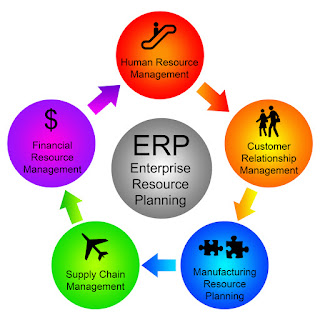
We all have heard success stories of enterprise resource planning (ERP) (click for presentation) software in different organisations. But a great number of ERP installations fail. Gartner mentions that about 75% of all ERP implementations fail .. Why is it that these implementations fail, even after committing so much of human resources, material resources, money, time etc to the project. 

No study of ERP systems is complete unless we make an earnest attempt to understand why ERP systems fail.

Though ERP systems are just a collection of basic RDBMS software that connects all the departments in an organisation to help in the smooth functioning of the organisation, maintain integrity of data, enable secure access of this centralised data, with a smooth software interface connecting the user, the customer, the server storing the centralised data, the implementation, upkeep and maintenance of the ERP system is very challenging.

I had my first experience on RDBMSs with Ingres working  on mini computers, then came Unisys, ( both at Goa Engineering College) and Oracle. Oracle now remains one of the top RDBMS sofware in the industry, mainly because of its reach and ability to convince customers of its user friendliness. 

In the free and open source software domain, we have two great RDBMSs , PostgreSQL and MySQL. MySQL was formerly powering Facebook but of late has been purchased by Oracle and to the best of my knowledge killed so that it would not be a competition to Oracle, the small commercial business package.  

RDBMSs form the basic component of any ERP package and SAP is now one of the most popular, widely used ERP software of the world. 

It makes better sense to study about any system by first having a general understanding of the system and then what are its drawbacks. The links given here are examples of failures or weaknesses of ERP packages and what could be done to overcome them.

Most of failure of ERP systems have taken place due to improper implementation.  Let us  look at what are the essential six phases of any ERP implementation.  In the Big Bang approach, the different stages of implementation are done serially and then in a big bang it is brought in line in a short period of time. This implementation process is very risky.
Organisations frequently go for the iterative approach where the implementation is done phase by phase with important departments in the organisation. The transition is slow and incremental. The advantage of this approach is that the errors in the implementation (inevitably there will be many) are progressively discovered and attended to, one at a time, so that the system does give a surprise to the organisation and keeps serving the basic interests of the customer and organisation and other stakeholders on a limited scale initially and then maturing to an advanced state later on.

Top 5 reasons why ERP implementations fail and what one can do about it .. Click here ..

A student report from UT Dallas on why ERP systems fail.. click here ..

ERP failure case at HP .. Click here ..

ICMR case on ERP Failure at HP ..

A Pemeco Consulting white paper on what led to ERP implemtation failure at Hershey's..

george..

Tuesday, October 10, 2017

Jack Ma on the 3Qs of the human body and the third technology revolution ..

The Chinese business magnate Jack Ma was recently speaking at a conference where he spoke of the 3Qs of the human body.

All of us are aware of the IQ and the EQ. But how many of us are aware of the LQ - love quotient ? Jack says that it is this quotient that is going to help the world survive for the next thirty years.

The first technology revolution released the human body from the bondages of hard and heavy work and gave him leisure, free time and improved productivity.

The second technology revolution concentrated around transportation and gave the humans the ability to cover distances by automobiles, trains, planes etc..

The third technology revolution revolved around knowledge and wisdom, the developments surrounding Information Technology and its effective use have taken mankind a lot ahead. People and countries have stated competing with each other based on the knowledge they have or they can generate, not based on how they could leverage the muscles and conquer distances.

These are thoughts from a very plain headed person who is one of the top rich persons on planet earth and leading the world in e-commerce..

George ..

Monday, October 09, 2017

Business Process Re-engineering - Basics and links ..


What is a business ?

An organization or economic system where goods and services are exchanged for one another or for money. Every business requires some form of investment and enough customers to whom its output can be sold on a consistent basis in order to make a profit. Businesses can be privately owned, not-for-profit or state-owned. -www.businessdictionary.com

Business process reengineering (BPR) is the analysis and redesign of workflows within and between enterprises in order to optimize end-to-end processes and automate non-value-added tasks. - what is.com

BPR - What to do if your business is failing .. 

A good BPR FAQ .. from albany.edu ..

A World Bank BPR presentation ..

A good presentation with case studies ..


Steps and procedures in BPR .. click here ..

Click here for the Hammer article Re-engineering work, dont automate, obliterate in HBR July '90

This document from Bain & Co has interesting links ..

Diff between BPR and Kaizen .. ( a student paper, but neatly written..)

How to make reengineering work, Hall et al, HBR, Nov '93

BPR as a quality improvement tool .


george..

Wednesday, October 04, 2017

How predictive shopping can remorph supply chain frontiers ..

Most of us by now are aware of the most common e-commerce business model of shopping-then-shipping. Once the customers makes the choice of items, the e-commerce portal would initiate operations to get the ordered items to reach the customer by accessing different databases.

With advances in Artificial Intelligence(AI) which we are advancedly witnessing in our daily lives, a day will come soon when AI would be able to predict with more than 50% probability items which we would like to purchase or are looking to purchase and the e-commerce portal would ship the items to us in advance of our placing orders. On receiving the items, the customer would favourably look up the items and select the items which he wanted to buy but never had the time or inclination to purchase. The business model now changes to shipping-then-shopping.

This idea was discussed by Prof. Ajay Agarwal and team from the Rotman School of Management, Toronto, Canada in the Oct issue of HBR. They looked at the benefits it can bring to an organisation in terms of the change in strategy it entails. But from a supply chain professional's view point, it makes more of business sense to catch the customer earlier before he goes to competitors and their products. This brings in better profitability and in the long run dedicated customer base and better customer retention.

Knowing your customers' likes and dislikes before-hand and shipping the required items to him with higher probability of acceptance, reaching anywhere near to 90% acceptability and a proportionally high profitability,(as sales are realised faster, reliably, with less costs and with less returns) would in fact be the utopia a supply chain professional would be dreaming in his organisation.

George..

Ref : 1. How AI will change strategy, a thought experiment, Ajay Agarwal et al, HBR, Oct, 2017.

I asked chatGPT to edit this text to make it superior, this is what it did..

As technology continues to advance, e-commerce businesses are beginning to explore new ways to improve their operations and customer experience. One such model, known as "shipping-then-shopping," utilizes artificial intelligence (AI) to predict customers' purchasing habits and ship items to them in advance of their placing an order.

This model, discussed by Professor Ajay Agarwal and his team from the Rotman School of Management in Toronto, Canada, in the October issue of the Harvard Business Review, has the potential to bring significant benefits to organizations. From a supply chain professional's perspective, this model allows for catching customers earlier before they turn to competitors, resulting in better profitability and a dedicated customer base.

By using AI to predict customers' likes and dislikes, and shipping items to them with a high probability of acceptance, businesses can reach an acceptability rate of nearly 90% and achieve higher profitability. This is due to faster sales, reliable delivery, lower costs, and fewer returns. In short, this model could be a supply chain professional's utopia in their organization.

How to do effective brainstorming ..

Rational left and the creative right ..
Brainstorming got a fillip after 1981 Nobel medicine laurete Dr Roger Sperry of Caltech proposed the Split Brain Theory back in the sixties, which stressed that the left hemisphere of the brain was more rational while the right hemisphere of the brain was more creative.  Click here for my blog .. The term 'brainstorming' was proposed by Alex Osborn in his 1953 book, Applied Imagination.

The latest research undertaken by Prof. Leigh Thompson of Kellogg School of Management, North western University US was very interesting.

Any brainstorming session would focus on two aspects to measure the efficacy of the output, one being the quantity of ideas generated during the session and second, the variety of ideas (flexibility) generated during the session. 

In a research on about 93 managers divided randomly into three member groups done by Leigh Thomson, members of half of these groups during the introduction session was each asked to narrate an embarrassing event in their life during the preceding six months and each of the other half group members were asked to narrate their achievements during the preceding six months. 

Leigh Thompson and her team gave ten minutes for the introduction part and ten minutes for the brainstorming. She then observed the efficacy of the brainstorming session in terms of quantity and variety of the ideas (fluency and flexibility). 

It was observed that the groups that were asked to introduce with embarrassing stories over the past six months generated 26% more ideas (fluency) spanning 15% more use categories (flexibility) than their counterparts who introduced themselves within the group with achievements over the preceding six months. 

What could be the reason for this change in group behaviour of the embarrassments narration group over the achievements narration groups. My thinking led me to come up with these few thoughts.

1. By narrating embarrassing events, the team members were more aware of their shortcomings and thus were at a lower ground of thinking to start with, which helped them generate more diverse fields ideas.
2. By narrating embarrassments and failures, the team members unconsciously did more of innovative and self-corrective thinking than the achievements narration group 
3. By narrating their embarrassing actions and at the same time listening to others' embarrassing episodes, there was more realistic evaluation of events than the achievements narration group.

I am planning to test this on my students in the class for a first hand understanding of the psychology behind this research finding.

george.

Ref : 1. Leigh Thompson, For better brainstorming, tell an embarrassing story, HBR, Oct, 2007

Monday, October 02, 2017

Crowd science - how to manage a crowd .

The recent deaths of 22 people at Elphinstone Railway station of the Mumbai suburban train system was very disturbing. The casualty was high because of our poor understanding of how crowds form and how they behave.

Crowd Dynamics explained - 6 vital questions answered.

1. What is a high density crowd ?
2. how can crowds be deadly ?
3. what is a crowd crush ?
4. what is crowd collapse ? 
5. How do people die either by crowd crush or crowd collapse ?
6. How to protect yourself in a crowd ?

Answers to vital questions that could save or kill you ..

Prof. David Still, Prof of crowd science, Manchester Uty explains .. 

True Indians ..

Cannot agree more with Justice Katju .. 

How much do you agree or disagree with this one year old post from former Justice Markandeya Katju praising Keralites to be the *only true Indians* featuring all desirable qualities of hard-work, tolerance, intelligence, magnanimity etc.. 

Quote : "Keralites are hard working, modest, and intelligent. They are broad minded, liberal, cosmopolitan and secular in their views (though no doubt there are a few exceptions ). All Indians must learn from them. Long live the Keralites !," : unquote. Justice Katju finishes off in what is clearly a long, glowing tribute to Malayalis.


Probably, Justice Katju would have read ancient world history when Cranganore in Kerala (Muziris) had great trade with ancient Rome even during 100 BC and was the largest trading post in this part of the world..

Findings from the Lost cities of the world Project supported by the Rockefeller Foundation. (Muziris is Lost Cities #3) is reported by The Guardian ..


George

Surat - worlds largest diamond processing center

Surat as the world's diamond-cutting capital Surat cuts and polishes roughly nearly 90% of the diamonds globally, in an industry running...

My popular posts over the last month ..